
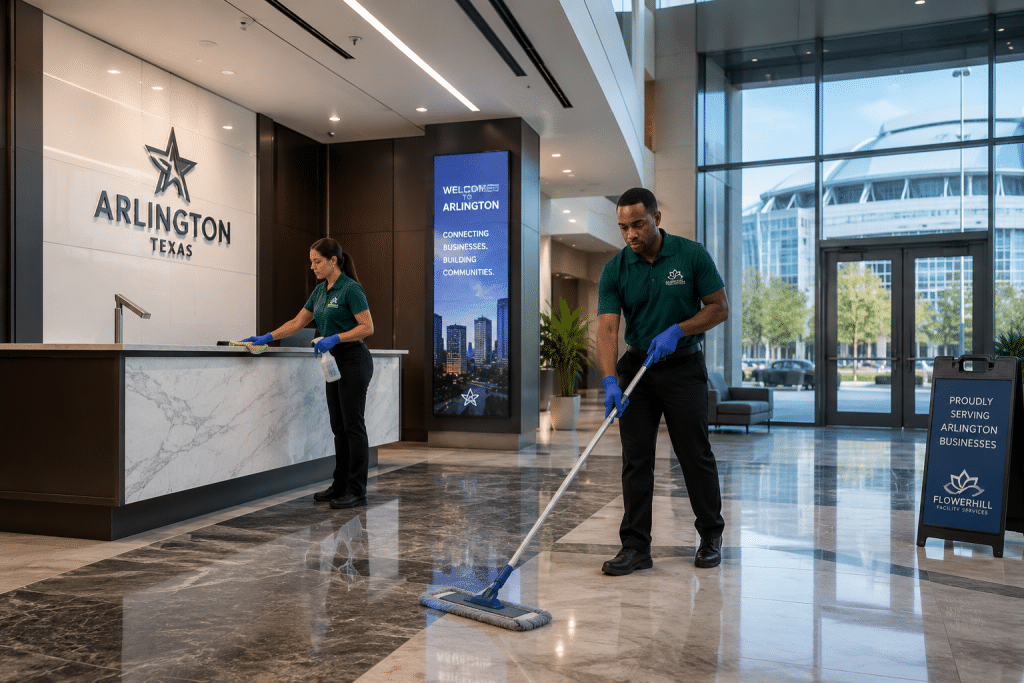
A day porter and a janitorial team solve different facility problems. Day porter service is typically focused on keeping a facility presentable and functional while people are using it. Janitorial service is typically structured around scheduled cleaning tasks performed at defined intervals, often before or after peak building activity.
For many DFW facilities, the right answer is not either/or. A busy property may use a porter during operating hours and janitorial service for deeper scheduled cleaning. The decision should be based on building traffic, risk areas, tenant expectations, operating hours, and the cleaning outcomes the facility manager needs to maintain.
Day porter vs. janitorial services at a glance
| Need | Day Porter | Janitorial Service |
|---|---|---|
| Visible support during business hours | Strong fit | Usually scheduled rather than continuous |
| Lobby, restroom, and common-area touchups | Strong fit | Handled on scheduled visits |
| Routine floor, restroom, trash, and surface cleaning | Supplemental | Core use case |
| Fast response to spills or high-traffic messes | Strong fit when porter is onsite | Depends on service schedule |
| After-hours cleaning program | Not usually the primary model | Strong fit |
| Large or high-traffic facility | Often useful | Often useful |
What does a day porter do?
A day porter supports the appearance and day-to-day readiness of a facility while employees, visitors, customers, students, tenants, or vendors are present. The exact scope should be defined in the service agreement, but common needs can include restroom checks, replenishment, touchpoint cleaning, lobby and common-area attention, trash monitoring, spill response, and other visible upkeep.
FlowerHill’s Day Porter Services page is the best starting point for facilities that need cleaning support during operating hours.
What does janitorial service do?
Janitorial service is generally a scheduled cleaning program built around repeatable tasks and frequencies. Depending on the facility, that can include restrooms, floors, trash, break areas, workspaces, common areas, and other agreed cleaning requirements.
For a deeper look at scheduled service, see FlowerHill’s Janitorial Services.
Choose a day porter when the problem happens during the day
A porter may be the better fit when a facility manager is repeatedly dealing with issues that occur between scheduled cleanings. Examples include high restroom traffic, busy lobbies, shared amenities, food and beverage areas, frequent deliveries, events, or facilities where appearance changes quickly throughout the day.
Choose janitorial service when consistency and scheduled scope are the priority
Janitorial service is often the better core program when a facility needs defined cleaning tasks completed on a repeat schedule. The focus is less on continuous daytime visibility and more on reliable execution of the agreed scope.
Use both when a facility needs daytime readiness and scheduled cleaning
Some properties need two layers: a daytime presence to maintain high-visibility areas and a scheduled janitorial program for the broader cleaning scope. This can be useful in larger offices, multi-tenant properties, schools, medical facilities, public-facing buildings, industrial sites, and other high-traffic environments.
Five questions to ask before choosing a cleaning model
- When do our cleaning problems actually happen? During operating hours, after hours, or both?
- Which areas create the most complaints or risk? Restrooms, entryways, breakrooms, production areas, floors, or shared spaces?
- How quickly must visible problems be corrected? A spill or overflowing trash container may need attention long before the next scheduled cleaning.
- Do we need a person onsite for recurring support tasks? If yes, a porter model may be important.
- What outcomes should be documented in the scope? Define tasks, frequencies, priority areas, communication, and quality expectations before service begins.
Local planning matters in DFW
Facility needs can vary widely across the Dallas-Fort Worth market. A professional office, warehouse, school, data center, healthcare setting, church, and multi-tenant property do not have identical traffic patterns or cleaning priorities.
For location-specific planning, FlowerHill maintains service-area information including Plano and other DFW communities, along with facility-specific information such as schools and universities, warehouses, and data centers.
Frequently asked questions
Is a day porter the same as a janitor?
Not exactly. The roles can overlap, but a day porter is commonly positioned around daytime facility readiness and visible upkeep, while janitorial service is commonly organized around scheduled cleaning tasks.
Can a facility use both services?
Yes. Many high-traffic facilities benefit from daytime attention plus a scheduled janitorial program.
Which service is better for an office building?
It depends on traffic, operating hours, tenant expectations, restroom usage, common areas, and how quickly problems need to be addressed during the day.
What should be included in a cleaning proposal?
The proposal should clearly define areas, tasks, frequencies, service windows, communication expectations, and any site-specific requirements.
Need help choosing the right DFW cleaning model?
A facility walkthrough can make the answer much clearer. Start with FlowerHill’s day porter and janitorial service information, then request a conversation about the scope that fits your building.