DALLAS - FORT WORTH'S PREFERRED COMMERCIAL CLEANING COMPANY

Medical Office Building Cleaning Services in Dallas-Fort Worth

Health Care Buildings – Fully Sanitized & Disinfected by Our Team

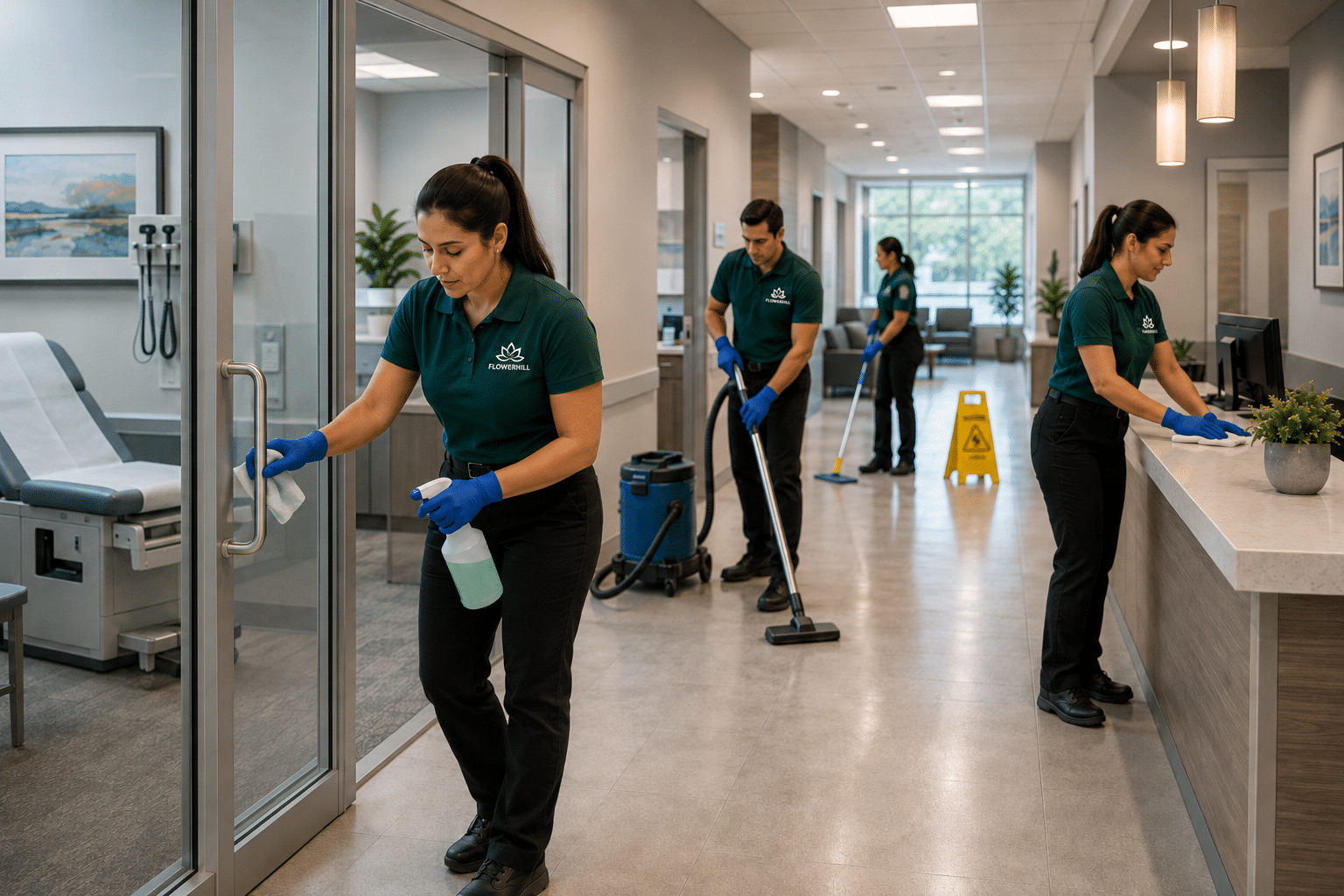
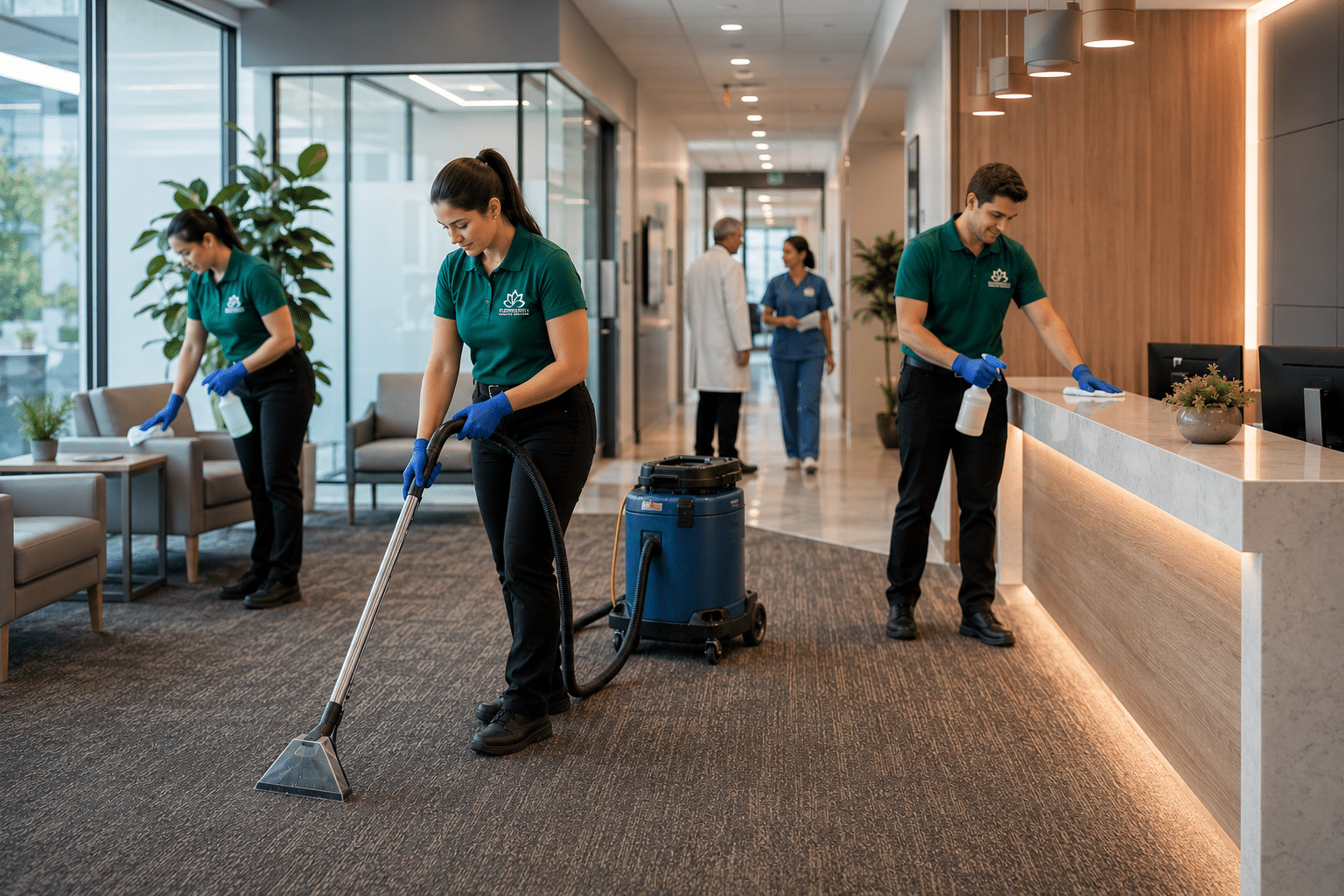
FlowerHill Facility Services provides customized medical office cleaning, healthcare janitorial, environmental cleaning, floor care, day porter, and facility-support services for medical office buildings, outpatient clinics, physician practices, specialty-care facilities, and healthcare-related properties throughout Dallas-Fort Worth.

Medical offices require a more carefully defined cleaning program than an ordinary commercial workplace. Patient traffic, clinical procedures, high-touch surfaces, treatment areas, restrooms, privacy requirements, medical equipment, regulated waste, bodily-fluid exposure, and facility-specific infection-prevention procedures can all affect how cleaning should be performed.

FlowerHill develops each program around the medical facility’s layout, patient population, services provided, operating hours, clinical areas, flooring, high-touch surfaces, security requirements, approved products, existing infection-prevention plan, and division of responsibilities between clinical and environmental-cleaning personnel.

Whether your property needs recurring medical office janitorial service, waiting-room and restroom maintenance, exam-room environmental cleaning, daytime porter coverage, hard-floor care, carpet cleaning, interior glass service, or scheduled deep-cleaning projects, FlowerHill can create a clearly documented scope for the areas under your responsibility.

What Are Medical Office Building Cleaning Services?

Medical office building cleaning includes the recurring and project-based care of approved patient-facing, clinical-support, administrative, employee, common, and building-service areas within an outpatient healthcare property.

A customized medical office cleaning program may include:

  • Waiting-room and reception-area cleaning
  • Patient check-in and check-out area care
  • Approved exam-room environmental cleaning
  • Consultation-room cleaning
  • Hallway, elevator, and common-area cleaning
  • Patient and visitor restroom cleaning
  • Staff restroom and breakroom service
  • Administrative office cleaning
  • Interior glass and entrance care
  • High-touch surface cleaning and disinfection
  • Hard-floor cleaning and periodic floor care
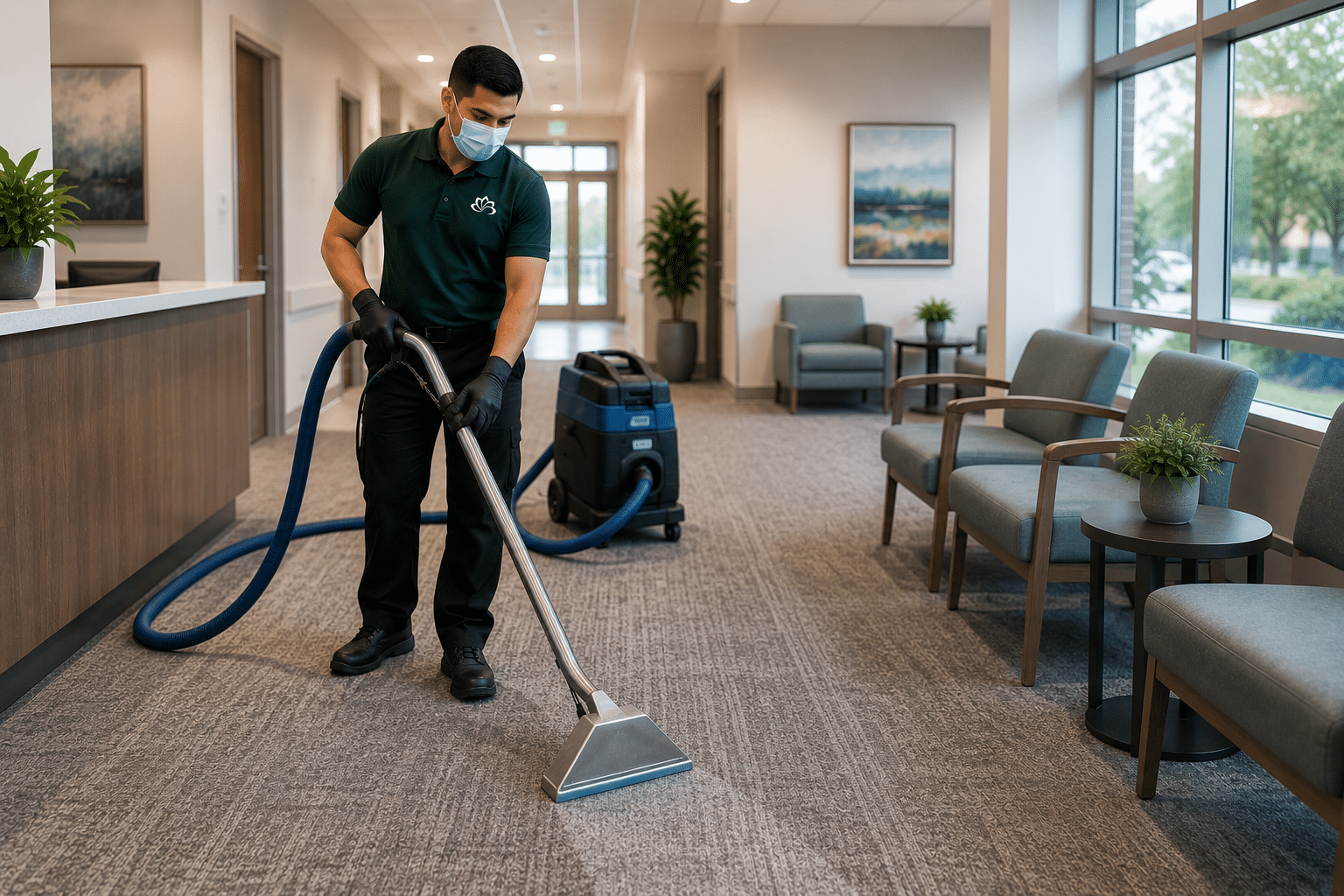
  • Carpet vacuuming, extraction, and spot treatment
  • Day porter services
  • General waste and approved recycling removal
  • Scheduled deep-cleaning projects
  • Move-in, turnover, and post-construction cleaning
  • Approved facility-maintenance support

The final scope depends on the type of medical practice, patient population, clinical procedures, surface materials, infection-prevention requirements, waste classifications, and responsibilities established during the facility walkthrough.

How Medical Office Cleaning Differs From Standard Office Cleaning

A traditional office-cleaning program primarily addresses workstations, conference rooms, restrooms, breakrooms, carpet, hard flooring, glass, dust, and general waste.

Medical office cleaning may include many of those responsibilities while also accounting for:

  • Patient-care and examination areas
  • Higher concentrations of frequently touched surfaces
  • Patients who may be more vulnerable to infection
  • Clinical workflow and appointment schedules
  • Potential exposure to blood or body fluids
  • Sharps and regulated medical waste
  • Patient-care equipment boundaries
  • Handwashing and clinical sinks
  • Procedure-room requirements
  • Facility-approved disinfectants
  • Required surface contact times
  • Dedicated or color-coded cleaning tools
  • Patient privacy and protected information
  • Clinical staff responsibilities
  • Cleaning documentation and checklists

The cleaning plan should distinguish general building cleaning from environmental cleaning within patient-care areas and from specialized clinical responsibilities that remain under the control of qualified healthcare personnel.

Cleaning, Disinfection, and Sterilization Are Different Services

Medical offices frequently use the terms cleaning, sanitizing, disinfection, and sterilization interchangeably, but they are not the same process.

Environmental Cleaning

Environmental cleaning removes visible soil, dust, organic material, residue, and debris from approved surfaces. Cleaning is generally required before effective disinfection can occur because surface soil may interfere with the performance of a disinfectant.

Environmental Surface Disinfection

Disinfection uses an appropriately selected product on an approved inanimate surface according to the product label, including required preparation, application, wet contact time, ventilation, personal protective equipment, and rinsing instructions.

Clinical Sterilization

Sterilization is a specialized process used for certain medical instruments, devices, and equipment. Instrument sterilization, autoclave operation, high-level disinfection, endoscope reprocessing, surgical-tool processing, and sterile-supply responsibilities are not ordinary janitorial services.

FlowerHill should only perform environmental cleaning and disinfection tasks that are specifically included in the approved scope. Sterilization and clinical-equipment reprocessing remain the responsibility of trained and authorized healthcare personnel unless separately assigned under an appropriate specialized agreement.

Medical Office Areas We Clean

Building Entrances and Vestibules

The entrance creates the first impression for patients, families, visitors, physicians, employees, vendors, and prospective tenants.

Entrance cleaning may include:

  • Cleaning entrance-door glass
  • Cleaning doors, handles, frames, and sidelights
  • Vacuuming or cleaning entrance mats
  • Sweeping and mopping hard floors
  • Removing visible soil and tracked-in debris
  • Cleaning approved high-touch surfaces
  • Emptying entrance waste containers
  • Cleaning approved seating or waiting surfaces
  • Reporting damaged doors, mats, flooring, or lighting

Lobbies and Shared Common Areas

Multi-tenant medical office buildings may contain shared lobbies, corridors, seating areas, elevators, restrooms, directories, and building-management spaces.

Common-area cleaning may include:

  • Hard-floor and carpet care
  • Lobby furniture surface cleaning
  • Interior glass cleaning
  • Elevator interior cleaning
  • Stair and handrail cleaning
  • Cleaning approved high-touch surfaces
  • General waste removal
  • Shared restroom cleaning
  • Entrance and vestibule maintenance
  • Day porter support

FlowerHill can divide responsibilities between property-managed common areas and the interiors of individual medical tenants.

Patient Waiting Rooms

Waiting rooms may experience continuous turnover involving patients, caregivers, children, mobility devices, personal belongings, food, beverages, and seasonal illness.

Approved waiting-room service may include:

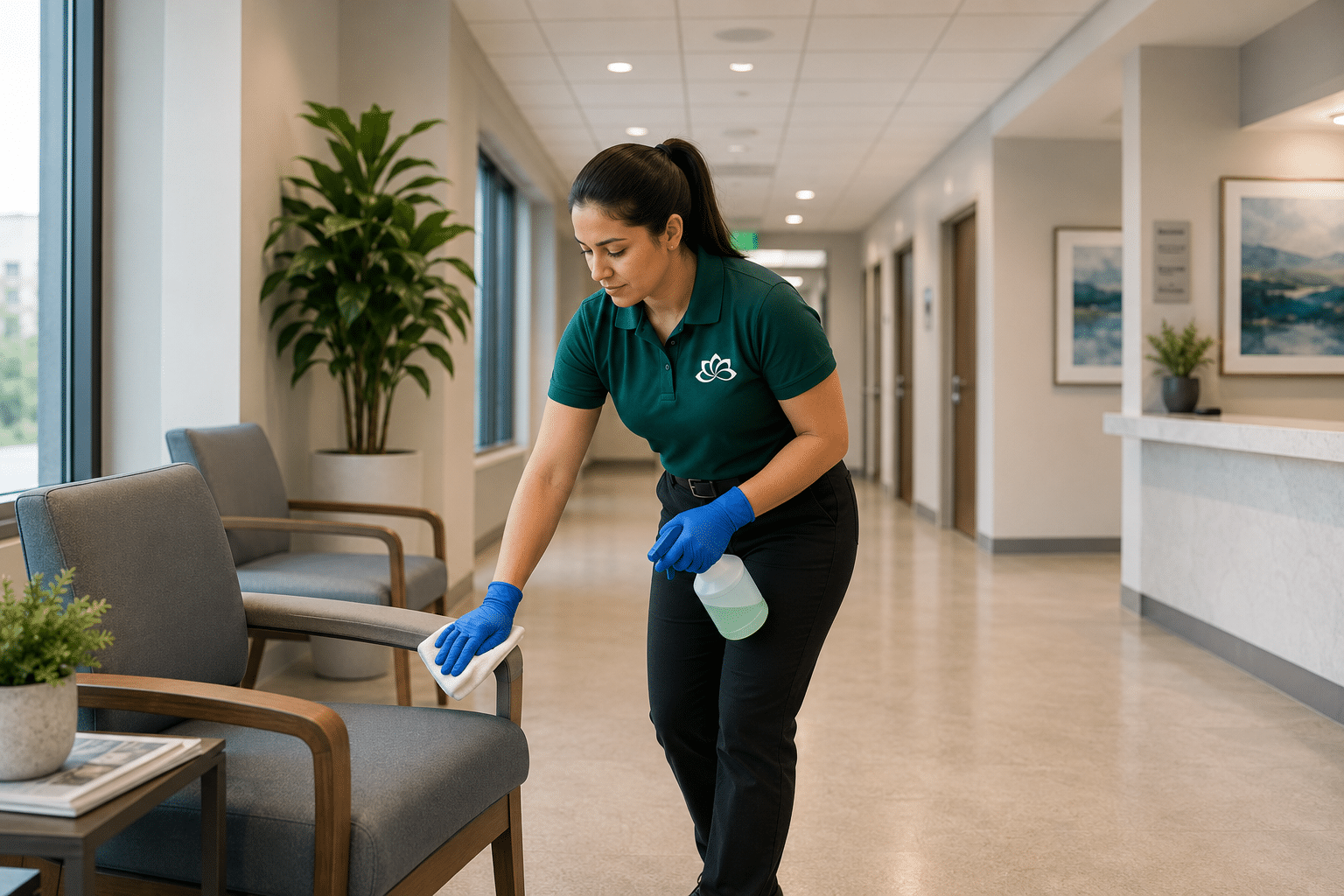
  • Cleaning approved seating surfaces
  • Cleaning armrests and chair frames
  • Cleaning tables and approved counters
  • Vacuuming carpet
  • Cleaning hard floors
  • Cleaning doors and interior glass
  • Cleaning approved high-touch surfaces
  • Removing general waste
  • Cleaning children’s areas when specifically assigned
  • Reporting damaged furniture or visibly soiled materials

Books, toys, tablets, beverage stations, patient forms, wheelchairs, medical devices, and specialty furnishings should only be handled according to the facility’s approved procedures.

Reception and Patient Check-In Areas

Reception areas combine customer service, patient communication, financial transactions, records, computers, phones, medical-office equipment, and frequent surface contact.

Approved cleaning may include:

  • Cleaning accessible counter surfaces
  • Cleaning transaction ledges
  • Cleaning doors, handles, and partitions
  • Cleaning approved seating areas
  • Vacuuming or mopping floors
  • Removing general waste
  • Cleaning approved high-touch surfaces
  • Interior glass care
  • Cleaning the surrounding reception environment

Patient files, printed schedules, identification documents, payment terminals, computers, keyboards, phones, clinical systems, login credentials, and other sensitive materials should not be moved or handled unless the facility has established a specific procedure.

Exam Rooms

Exam rooms may contain treatment tables, chairs, counters, sinks, cabinets, medical equipment, supplies, waste containers, and frequently touched surfaces.

An approved environmental-cleaning scope may include:

  • Cleaning and disinfecting designated environmental surfaces
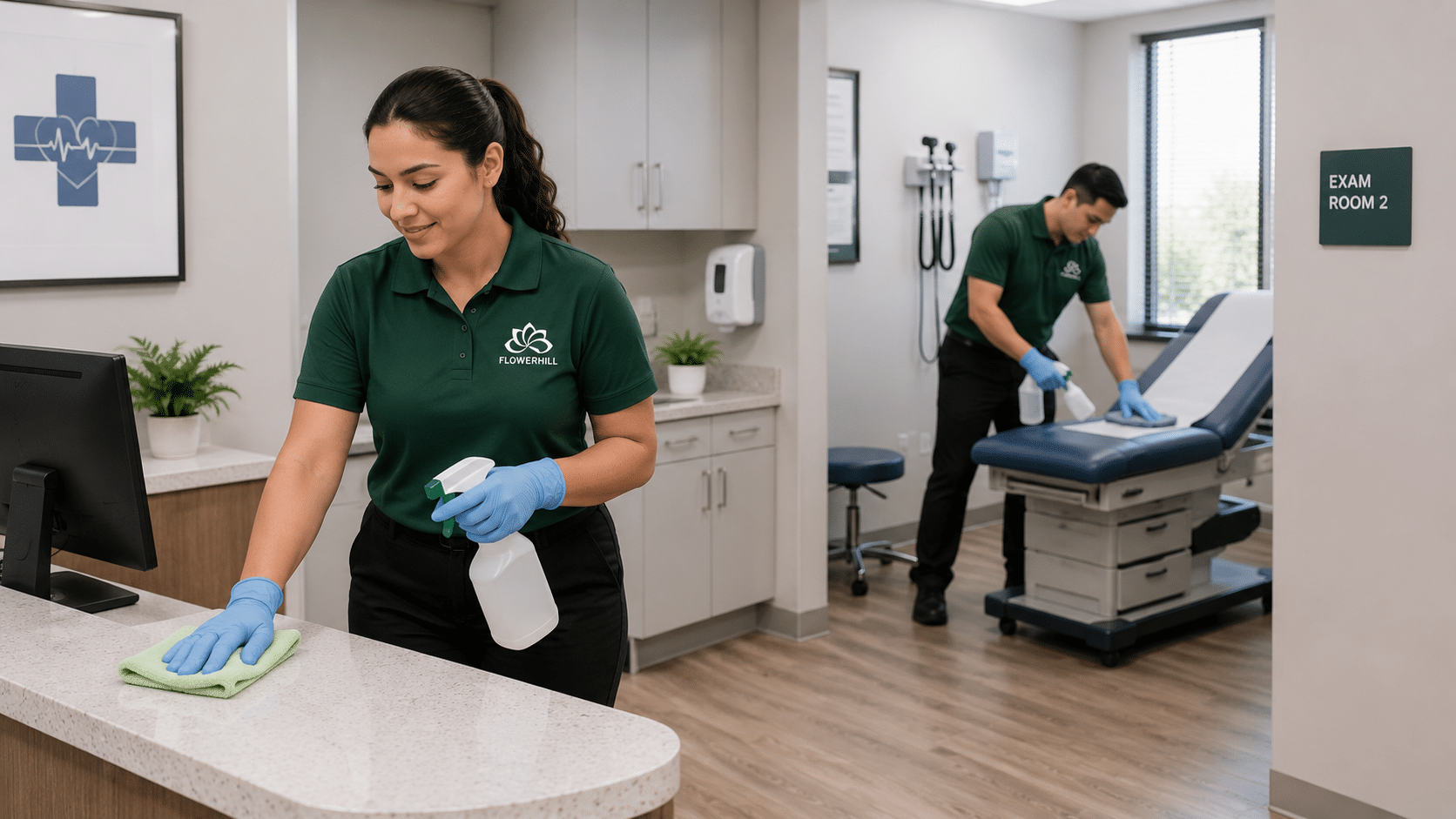
  • Cleaning approved exam-table exterior surfaces
  • Cleaning counters after clinical materials have been removed
  • Cleaning sinks, faucets, and surrounding surfaces
  • Cleaning doors, handles, and light switches
  • Cleaning approved seating surfaces
  • Cleaning floors
  • Removing general waste
  • Replacing liners in approved containers
  • Reporting visibly damaged or heavily soiled surfaces

The medical practice should identify which surfaces are cleaned between patients, which tasks are completed by clinical personnel, which tasks are assigned to FlowerHill, and which products and contact times are required.

FlowerHill personnel should not move medications, handle instruments, dispose of sharps, clean internal medical devices, restock clinical supplies, operate examination equipment, or process reusable patient-care equipment unless those duties have been specifically evaluated and assigned.

Consultation Rooms

Consultation rooms may resemble ordinary offices but still receive patients and families throughout the day.

Cleaning may include:

  • Accessible surface dusting
  • Approved desk and counter cleaning
  • Chair and table surface cleaning
  • Trash removal
  • Carpet vacuuming
  • Hard-floor cleaning
  • Door and interior-glass cleaning
  • Cleaning approved touchpoints

Medical charts, documents, laptops, monitors, patient education materials, models, diagnostic equipment, and personal property should remain undisturbed.

Minor Procedure and Treatment Rooms

Some outpatient facilities perform wound care, injections, biopsies, infusions, suturing, dermatologic procedures, minor surgery, or other clinical treatments.

Cleaning these rooms requires a practice-specific assessment because procedures may create different levels of contamination and different cleaning needs.

Before FlowerHill accepts responsibility, the facility should define:

  • Which procedures are performed
  • Which surfaces FlowerHill may clean
  • When cleaning occurs
  • Whether cleaning is required between patients
  • Who removes instruments and clinical supplies
  • Who handles sharps and regulated medical waste
  • Which products are approved
  • Required product contact times
  • Required personal protective equipment
  • Blood or body-fluid response procedures
  • Who inspects and releases the room

FlowerHill should not automatically represent routine janitorial personnel as qualified to perform surgical-suite cleaning, sterile processing, high-level disinfection, instrument reprocessing, operating-room terminal cleaning, or other specialized clinical sanitation.

Clinical Workstations and Nurse Stations

Clinical workstations may contain records, medications, phones, computers, scanners, specimen labels, patient-care equipment, and active clinical materials.

Approved cleaning may include:

  • Cleaning accessible cleared surfaces
  • Cleaning surrounding floors
  • Removing approved general waste
  • Cleaning doors and partitions
  • Cleaning approved seating surfaces
  • Cleaning sinks when assigned
  • Cleaning approved high-touch environmental surfaces

Medication-preparation surfaces, clinical records, computers, keyboards, specimen materials, diagnostic devices, medical supplies, and patient-care equipment should only be cleaned according to the facility’s written procedures.

Patient Restrooms

Patient and visitor restrooms are frequently used and may require more attention than restrooms within a conventional office building.

Restroom service may include:

  • Cleaning and disinfecting toilets and urinals
  • Cleaning sinks, faucets, counters, and fixtures
  • Cleaning mirrors and partitions
  • Cleaning door handles and approved touchpoints
  • Sweeping and mopping floors
  • Removing general and sanitary waste
  • Replacing approved container liners
  • Restocking toilet tissue
  • Restocking paper towels
  • Replenishing soap and approved consumables
  • Monitoring odor and presentation
  • Reporting clogs, leaks, damage, or unusual contamination

Separate tools should be used for restroom cleaning when required by the medical facility’s environmental-cleaning program.

Staff Restrooms and Changing Areas

Staff facilities may include private restrooms, lockers, changing rooms, showers, uniform areas, or hygiene spaces.

Approved service may include:

  • Cleaning fixtures, partitions, and mirrors
  • Cleaning floors and walkways
  • Cleaning showers when included
  • Cleaning benches and approved locker exteriors
  • Removing waste
  • Restocking approved supplies
  • Reporting leaks or facility damage

Uniforms, laboratory coats, personal belongings, protective equipment, laundry, linens, and locker interiors should only be handled when clearly assigned.

Staff Breakrooms and Kitchens

Healthcare employees may use breakrooms throughout long shifts, creating concentrated food, beverage, waste, and surface-cleaning needs.

Cleaning may include:

  • Cleaning tables and seating surfaces
  • Cleaning counters and sinks
  • Cleaning exterior appliance surfaces
  • Maintaining coffee and beverage stations
  • Removing general waste and approved recycling
  • Sweeping and mopping floors
  • Cleaning approved touchpoints
  • Restocking assigned consumables
  • Cleaning doors and interior glass

Employee food, dishes, personal belongings, refrigerator contents, medication, breast milk, specimens, vending equipment, and appliance interiors should only be included when expressly assigned.

Administrative Offices

Medical office buildings may contain human-resources departments, billing teams, scheduling departments, practice management, executive offices, call centers, records departments, and property-management offices.

Administrative cleaning may include:

  • Accessible surface dusting
  • General waste and recycling removal
  • Carpet vacuuming
  • Hard-floor cleaning
  • Cleaning approved common surfaces
  • Conference-room cleaning
  • Interior glass care
  • Breakroom and restroom service

Patient records, financial documents, computers, screens, identification information, filing systems, mail, and confidential materials should remain undisturbed.

Conference and Training Rooms

Healthcare organizations may use meeting spaces for clinical education, compliance training, staff meetings, vendor presentations, and community programs.

Cleaning may include:

  • Cleaning tables and approved seating surfaces
  • Removing general waste
  • Vacuuming or mopping floors
  • Cleaning doors and interior glass
  • Cleaning approved touchpoints
  • Resetting furniture to an approved arrangement
  • Maintaining adjacent refreshment areas

Hallways and Clinical Corridors

Medical corridors connect waiting rooms, exam rooms, procedure areas, offices, restrooms, and building common areas.

Approved cleaning may include:

  • Vacuuming and hard-floor cleaning
  • Cleaning handrails
  • Cleaning approved wall protection
  • Removing visible spots from doors and walls
  • Cleaning approved high-touch surfaces
  • Maintaining clear pedestrian routes
  • Reporting damaged flooring, walls, lights, or fixtures

Cleaning routes should be coordinated around patient movement, clinical workflow, wheelchairs, mobility devices, emergency access, carts, and staff traffic.

Elevators and Stairwells

Elevators and stairwells may be shared by patients, visitors, employees, delivery personnel, service providers, and multiple medical tenants.

Cleaning may include:

  • Cleaning elevator floors
  • Cleaning approved wall and door surfaces
  • Cleaning handrails
  • Cleaning approved control-panel surroundings
  • Cleaning stair treads and landings
  • Cleaning stair rails
  • Removing litter
  • Reporting damaged or unsafe conditions

Imaging and Diagnostic Facilities

Medical office properties may house imaging centers, ultrasound practices, mammography facilities, diagnostic laboratories, and testing centers.

FlowerHill may clean approved waiting rooms, offices, restrooms, changing areas, corridors, consultation rooms, floors, environmental surfaces, and support spaces.

Imaging machines, control consoles, radiation equipment, diagnostic devices, patient-positioning components, testing equipment, contrast materials, lead protection, and technical rooms require facility-approved procedures and appropriately qualified personnel.

Physical Therapy and Rehabilitation Clinics

Physical therapy and rehabilitation facilities may contain treatment tables, exercise equipment, therapy devices, open treatment areas, changing rooms, offices, and patient restrooms.

Approved cleaning may include:

  • Cleaning environmental surfaces
  • Cleaning approved table exteriors
  • Cleaning floors and walkways
  • Cleaning mirrors and interior glass
  • Cleaning approved seating surfaces
  • General waste removal
  • Restroom and changing-room cleaning
  • Cleaning approved equipment exteriors

Therapy equipment, resistance devices, clinical tools, treatment accessories, patient-contact items, and specialized surfaces should only be included when clearly identified by the clinic.

Behavioral and Mental Health Offices

Behavioral health facilities may include waiting rooms, consultation offices, group rooms, administrative areas, restrooms, and controlled patient spaces.

Cleaning should account for privacy, patient occupancy, furniture selection, restricted items, security procedures, and the facility’s approach to potentially vulnerable patients.

Pediatric Medical Offices

Pediatric practices may contain children’s waiting areas, exam rooms, parent seating, changing surfaces, toys, books, and other frequently handled items.

The clinic should clearly assign responsibility for toys, play equipment, changing stations, medical devices, and between-patient environmental cleaning. FlowerHill can incorporate approved surfaces into a documented cleaning schedule when appropriate procedures and products have been established.

Urgent Care and Walk-In Clinics

Urgent care centers may operate extended hours and encounter unpredictable patient volume, seasonal illness, minor procedures, bodily-fluid incidents, and frequent room turnover.

Cleaning programs may require:

  • Extended or evening service
  • Day porter coverage
  • Frequent restroom inspections
  • Waiting-room attention
  • Exam-room environmental cleaning
  • Clearly assigned between-patient responsibilities
  • Routine non-hazardous spill response
  • Blood or body-fluid response procedures
  • End-of-day cleaning
  • Supply and waste coordination

Specialty Medical Practices

FlowerHill may develop customized programs for approved areas within:

  • Primary-care offices
  • Family medicine practices
  • Internal medicine offices
  • Cardiology practices
  • Dermatology offices
  • Orthopedic clinics
  • Women’s health practices
  • Pediatric offices
  • Allergy and immunology clinics
  • Ear, nose, and throat practices
  • Ophthalmology and optometry offices
  • Physical therapy facilities
  • Behavioral health practices
  • Outpatient imaging centers
  • Urgent care centers
  • Occupational health clinics
  • Dental and oral-health offices
  • Other outpatient healthcare properties

Each specialty may have different treatment procedures, patient risks, equipment, products, room-turnover requirements, and environmental-cleaning responsibilities.

High-Touch Surface Cleaning and Disinfection

High-touch surfaces are surfaces that patients, visitors, providers, and employees contact frequently throughout the day.

Depending on the room and approved scope, these may include:

  • Door handles and push plates
  • Light switches
  • Chair arms
  • Reception counters
  • Check-in surfaces
  • Handrails
  • Elevator buttons
  • Faucet handles
  • Restroom fixtures
  • Exam-room counters
  • Approved exam-table surfaces
  • Cabinet and drawer handles
  • Shared environmental controls
  • Approved equipment handles

High-touch surfaces should be identified with the medical facility because the most frequently contacted items can differ by room, workflow, practice type, and patient population.

The approved checklist should identify which surfaces are cleaned, which are disinfected, how frequently they receive attention, which product is used, and whether the task belongs to FlowerHill or clinical personnel.

Routine Cleaning, Between-Patient Cleaning, and End-of-Day Cleaning

Routine Cleaning

Routine cleaning may occur during the day or after hours and may include waiting rooms, corridors, restrooms, offices, floors, general environmental surfaces, and approved patient-care spaces.

Between-Patient Cleaning

Some exam, therapy, diagnostic, or procedure areas may require cleaning or disinfection between patients.

The facility must define:

  • Which rooms require between-patient attention
  • Which surfaces are included
  • Who removes paper, linens, instruments, and supplies
  • Which products are used
  • Required contact times
  • Whether the room may remain occupied
  • Who confirms that the room is ready

Between-patient service is not automatically included in a standard evening janitorial agreement.

End-of-Day Cleaning

End-of-day cleaning may include approved patient-care environmental surfaces, floors, sinks, restrooms, waiting areas, offices, waste, and other areas identified by the medical facility.

FlowerHill can coordinate end-of-day responsibilities with the practice’s closing procedures so clinical items are removed and approved surfaces are available for cleaning.

Day Porter Services for Medical Office Buildings

Medical facilities may need visible cleaning support throughout operating hours, especially when they serve a high volume of patients or contain multiple medical tenants.

A FlowerHill medical office day porter may assist with:

  • Waiting-room presentation
  • Lobby and entrance care
  • Patient restroom inspections
  • Restroom supply replenishment
  • General waste removal
  • Routine non-hazardous spill cleanup
  • Cleaning approved high-touch surfaces
  • Interior entrance-glass cleaning
  • Elevator and corridor attention
  • Conference-room resets
  • Staff breakroom upkeep
  • Reporting visible facility concerns

Porter responsibilities inside exam rooms, procedure areas, laboratories, medication rooms, and other clinical spaces must be specifically defined.

Medical Office Floor Cleaning and Care

Medical offices may contain several flooring types within the same building or tenant suite.

These may include:

  • Luxury vinyl tile
  • Vinyl composition tile
  • Sheet vinyl
  • Rubber flooring
  • Ceramic or porcelain tile
  • Terrazzo
  • Sealed concrete
  • Commercial carpet
  • Entrance matting
  • Specialty clinical flooring

An approved floor-care program may include:

  • Routine vacuuming
  • Dust mopping
  • Damp mopping
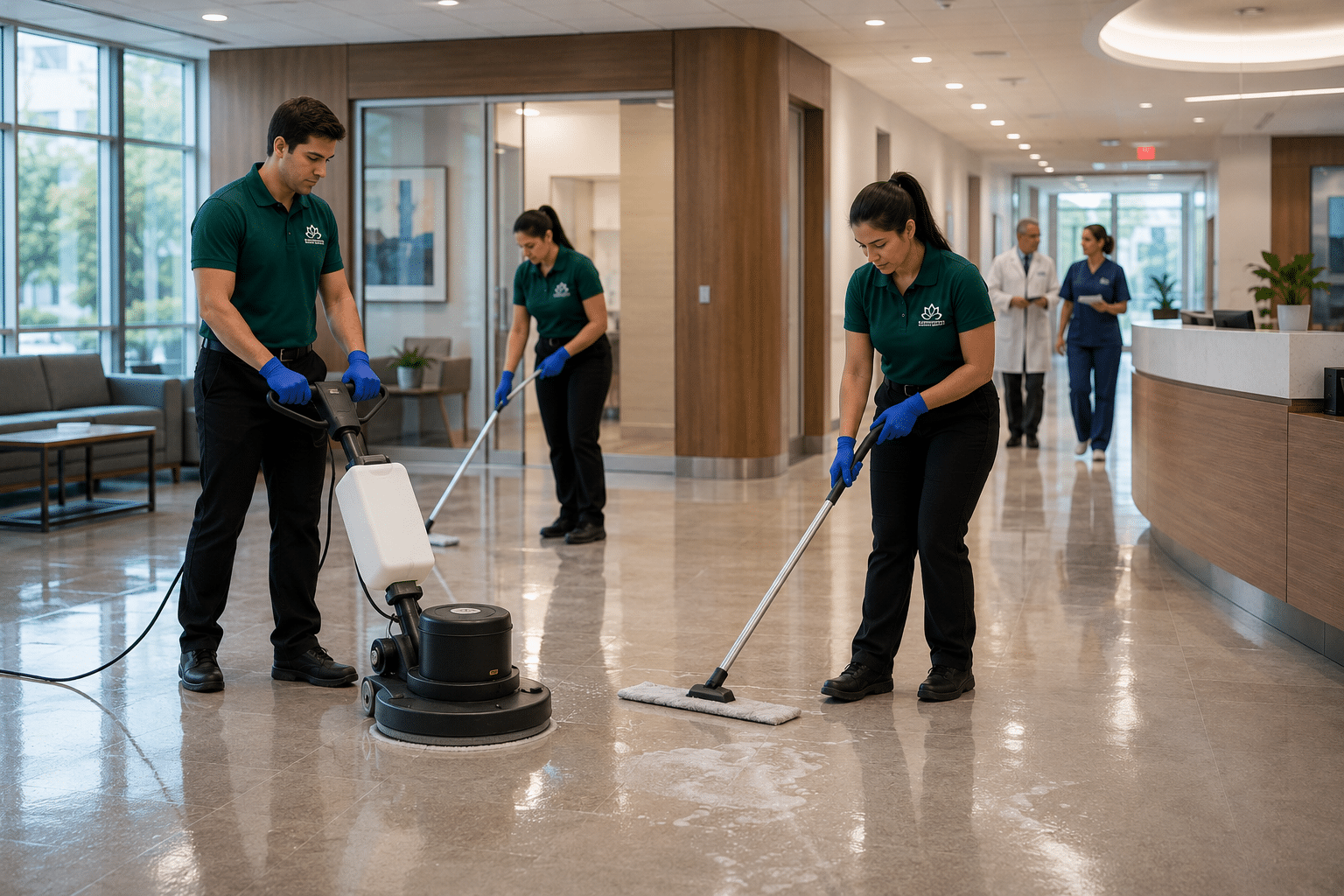
  • Machine scrubbing
  • Cleaning floor edges and corners
  • Routine spot treatment
  • Carpet extraction
  • Approved floor-finish maintenance
  • Stripping and refinishing suitable surfaces
  • Entrance-mat maintenance
  • Scheduled deep cleaning

Floor-care methods should be based on the flooring manufacturer’s recommendations, surface condition, slip resistance, clinical use, patient traffic, product compatibility, drying time, and facility schedule.

FlowerHill should not promise that cleaning prevents falls, prevents infection, extends flooring life for a guaranteed period, or eliminates the need for replacement.

Medical Office Carpet Cleaning

Carpeted offices, waiting areas, corridors, and consultation rooms may collect tracked-in soil, dust, spills, and visible staining.

Carpet services may include:

  • Routine commercial vacuuming
  • Edge and corner vacuuming
  • Approved spot treatment
  • Low-moisture interim cleaning
  • Scheduled hot-water extraction
  • Entrance-mat cleaning
  • Post-construction carpet cleaning

Blood, body fluids, hazardous materials, unknown staining, damaged carpet, and contaminated porous surfaces require separate assessment.

Interior Glass and Window Cleaning

Interior glass may include entrance doors, waiting-room partitions, reception windows, office fronts, consultation-room glass, and common-area windows.

Approved services may include:

  • Removing fingerprints and smudges
  • Cleaning accessible interior windows
  • Cleaning glass doors and sidelights
  • Cleaning approved partitions
  • Cleaning accessible frames and ledges
  • Scheduled exterior window service

Privacy films, specialty coatings, radiation shielding, damaged glass, elevated exterior windows, and controlled clinical windows should be evaluated before service.

Cross-Contamination Controls

A medical office cleaning program may incorporate procedures intended to prevent soil and cleaning tools from being transferred between areas.

Depending on the facility, these controls may include:

  • Color-coded microfiber cloths
  • Dedicated restroom tools
  • Separate patient-care and office tools
  • Fresh cloths for designated rooms or zones
  • Defined clean-to-dirty cleaning sequences
  • Defined high-to-low cleaning sequences
  • Separate mop heads for designated areas
  • Controlled chemical containers
  • Approved tool-storage locations
  • Proper handling of used cloths and mop heads
  • Clearly labeled supplies
  • Documented cleaning routes

The exact system should be developed around the medical practice’s rooms, procedures, patient risks, and infection-prevention plan.

Cleaning Products and Disinfectant Use

Medical facilities should approve the products used within patient-care, public, employee, and administrative areas.

The product program may define:

  • Approved cleaners and disinfectants
  • Authorized application areas
  • Compatible surfaces
  • Target organisms when relevant
  • Dilution or preparation requirements
  • Required wet contact time
  • Rinsing instructions
  • Ventilation requirements
  • Personal protective equipment
  • Storage and labeling procedures
  • Safety data sheet availability
  • Fragrance or sensitivity restrictions
  • Procedures for damaged or porous surfaces

A product should not be represented as effective against a particular organism unless that use is supported by its current EPA-approved label. The surface must remain visibly wet for the label-directed contact time when required.

Electrostatic Spraying, Misting, and Fogging

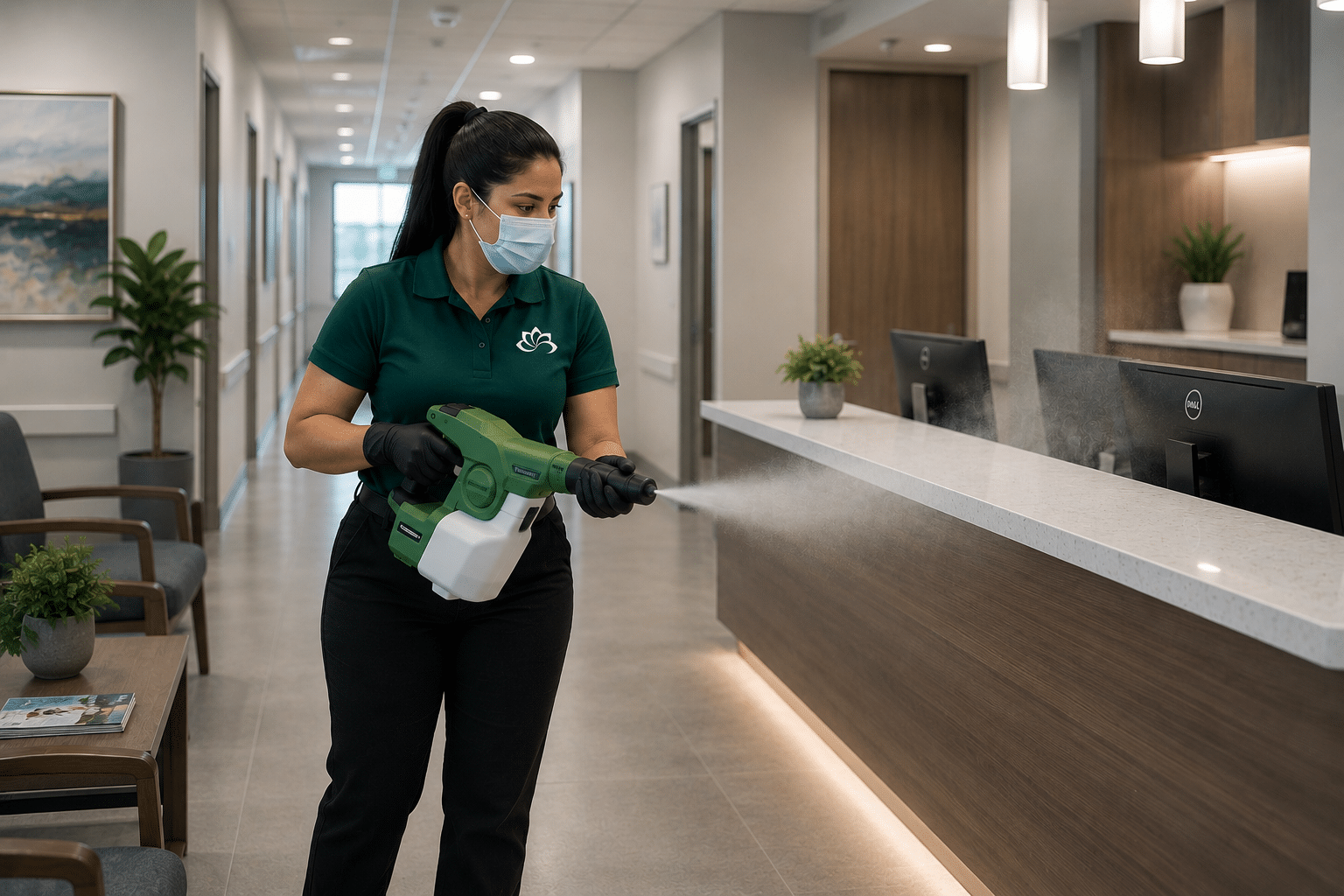
Electrostatic spraying, misting, and fogging should not be marketed as universal substitutes for manual environmental cleaning.

Any application technology should only be considered when:

  • The medical facility has approved the process
  • The product label authorizes the intended application method
  • The surface type is compatible
  • The required product concentration is maintained
  • The specified contact time can be achieved
  • Ventilation and occupancy requirements are followed
  • Appropriate personal protective equipment is used
  • Manual pre-cleaning is completed when required
  • Electronic and medical equipment are protected

FlowerHill should not claim “360-degree pathogen elimination,” total room sterilization, automatic air disinfection, or guaranteed infection prevention from an electrostatic application.

Blood and Body-Fluid Response Boundaries

Housekeeping personnel may encounter blood or other potentially infectious materials within medical environments.

Before FlowerHill accepts responsibility for blood or body-fluid cleanup, the parties should define:

  • Whether FlowerHill personnel are expected to perform the task
  • Which employees are trained and authorized
  • Required personal protective equipment
  • Exposure-control procedures
  • Approved disinfectants
  • Containment and disposal procedures
  • Sharps and broken-glass procedures
  • Exposure-incident reporting
  • Post-exposure evaluation responsibilities
  • Areas or conditions requiring a specialist

Routine janitorial service does not automatically include substantial blood releases, trauma scenes, unattended deaths, infectious-disease remediation, sewage, hazardous biological materials, or other specialized biohazard conditions.

Sharps and Regulated Medical Waste

Medical facilities may generate needles, lancets, blades, specimen materials, contaminated disposables, pharmaceutical waste, and other regulated medical waste.

Unless FlowerHill has been specifically trained, equipped, insured, and contracted for these duties, its personnel should not:

  • Pick up loose sharps by hand
  • Reach into waste containers
  • Compress medical waste bags
  • Empty sharps containers
  • Transfer sharps between containers
  • Handle leaking medical-waste containers
  • Transport regulated medical waste
  • Handle pharmaceutical or chemotherapy waste
  • Remove specimen containers

The medical facility should provide clearly labeled containers and a reporting procedure for overfilled, damaged, leaking, or improperly discarded materials.

Laboratory and Specimen Collection Areas

Some medical offices contain blood-draw rooms, specimen collection areas, point-of-care testing rooms, or laboratories.

FlowerHill may clean approved general environmental surfaces after specimens, reagents, sharps, instruments, and testing materials have been secured by clinical personnel.

The following tasks are not automatically included:

  • Handling blood or specimen tubes
  • Cleaning laboratory instruments
  • Handling cultures or reagents
  • Cleaning centrifuges or analyzers
  • Disposing of specimen materials
  • Handling laboratory chemicals
  • Cleaning biological safety cabinets
  • Managing regulated laboratory waste

Medication and Pharmacy Areas

Medication rooms, vaccine-storage areas, infusion-preparation spaces, and pharmacies require carefully controlled access and clearly assigned cleaning responsibilities.

FlowerHill may clean authorized floors and cleared environmental surfaces when the medical facility has established the appropriate products, procedures, access conditions, and supervision.

Cleaning personnel should not move medications, open refrigerators, handle controlled substances, clean sterile-compounding environments, dispose of pharmaceuticals, or interfere with medication-preparation surfaces unless separately authorized and qualified.

Patient Privacy and Information Security

Cleaning personnel may work near patient records, appointment schedules, billing information, computer screens, labels, prescriptions, medical devices, and confidential conversations.

A medical office cleaning program may include:

  • Restricted access to records areas
  • Prohibitions against moving documents
  • Requirements to avoid viewing computer screens
  • Secure key and badge procedures
  • Photography and mobile-device restrictions
  • Confidentiality expectations
  • Procedures for discovered documents
  • Incident-reporting requirements

FlowerHill should not advertise blanket “HIPAA certification” unless the company has determined its actual legal role and can document the applicable training, agreements, policies, and safeguards.

Medical Office Waste and Recycling

FlowerHill may remove ordinary waste and approved recycling from offices, waiting rooms, restrooms, breakrooms, and other designated areas.

The scope should clearly distinguish:

  • Ordinary municipal waste
  • Approved office recycling
  • Confidential paper
  • Sharps
  • Red-bag or regulated medical waste
  • Pharmaceutical waste
  • Chemotherapy waste
  • Laboratory waste
  • Electronic equipment
  • Hazardous chemicals
  • Patient specimens

Confidential documents should be placed in designated secure containers rather than ordinary trash or recycling unless the facility directs otherwise.

After-Hours Medical Office Cleaning

Many medical practices prefer evening or overnight cleaning to reduce interference with appointments and clinical workflow.

An after-hours plan may address:

  • Building and tenant access
  • Keys, badges, and alarm systems
  • Restricted clinical rooms
  • Approved storage locations
  • Patient-record security
  • Locked medication areas
  • End-of-day room preparation
  • Closing and reopening procedures
  • Emergency contacts
  • Areas that remain occupied

FlowerHill can coordinate separate service windows for common areas, individual practices, urgent care operations, and tenants with extended schedules.

Multi-Tenant Medical Office Building Cleaning

A medical office building may house several independent practices with different operating hours, patient populations, services, security requirements, and cleaning responsibilities.

Property-Management Cleaning

Property-managed service may include:

  • Building entrances
  • Shared lobbies
  • Common corridors
  • Elevators and stairs
  • Shared restrooms
  • Building-management offices
  • Vacant suites
  • Common-area floor care
  • Exterior entrance areas
  • Day porter coverage

Individual Medical-Tenant Cleaning

Tenant service may include:

  • Waiting and reception areas
  • Exam-room environmental surfaces
  • Consultation rooms
  • Administrative offices
  • Private restrooms
  • Staff breakrooms
  • Clinical corridors
  • Approved patient-care areas
  • Interior glass
  • General waste

Each practice can have a separate scope, schedule, product list, access procedure, and designated point of contact.

Vacant-Suite, Move-In, and Turnover Cleaning

Medical suites may require detailed cleaning before leasing tours, after a tenant leaves, following construction, or before a new practice opens.

Approved turnover services may include:

  • Removing authorized loose debris
  • Detailed dust removal
  • Cleaning offices and consultation rooms
  • Cleaning restrooms and breakrooms
  • Carpet vacuuming and extraction
  • Hard-floor cleaning
  • Interior glass cleaning
  • Cleaning doors, frames, and partitions
  • Cleaning cleared cabinets and counters
  • Post-construction touch-up cleaning
  • Final presentation cleaning

Abandoned medication, sharps, specimens, medical devices, records, chemicals, equipment, patient materials, or regulated waste require written handling and disposal instructions.

Post-Construction Medical Office Cleaning

Medical office construction and renovation may generate fine dust, labels, protective films, adhesive residue, packaging, and contractor debris.

Post-construction cleaning may include:

  • Removing approved loose construction debris
  • Detailed surface dust removal
  • Cleaning walls, doors, and frames
  • Cleaning interior glass
  • Cleaning restrooms and staff areas
  • Cleaning approved cabinets and fixtures
  • Carpet cleaning
  • Hard-floor cleaning
  • Removing authorized labels and protective film
  • Final cleaning before furniture or equipment installation
  • Final presentation cleaning before opening

Post-construction cleaning should be coordinated around contractors, inspections, commissioning, medical-equipment installation, remaining punch-list work, HVAC operation, infection-control requirements, and the anticipated opening date.

Documentation, Checklists, and Quality Control

Medical office cleaning responsibilities should be documented so environmental and clinical tasks are not missed because each party assumes the other will perform them.

Depending on the approved program, FlowerHill may provide:

  • Area-specific cleaning checklists
  • Task and frequency schedules
  • Restroom inspection logs
  • Day porter service logs
  • Floor-care records
  • Product and dilution documentation
  • Corrective-cleaning reports
  • Supervisor inspections
  • Access and exception reports
  • Supply-restocking reports
  • Client review meetings
  • Photographic documentation when permitted

Clinical release decisions, infection surveillance, environmental cultures, ATP testing, microbiological testing, outbreak investigations, and regulatory documentation should only be included when FlowerHill’s role and qualifications have been formally established.

Routine Medical Cleaning vs. Specialized Healthcare Services

Routine medical office cleaning may include waiting rooms, offices, restrooms, breakrooms, corridors, floors, glass, general waste, and approved exam-room environmental surfaces.

Environmental surface disinfection may include specifically identified surfaces using facility-approved products and methods.

Day porter service provides ongoing attention to waiting rooms, restrooms, entrances, waste, and visible facility needs during operating hours.

Project cleaning may include carpet extraction, floor refinishing, post-construction cleaning, vacant-suite cleaning, detailed high dusting, and scheduled deep cleaning.

Specialized healthcare sanitation may include operating-room cleaning, isolation-room cleaning, instrument sterilization, sterile processing, laboratory decontamination, pharmacy-compounding cleaning, biohazard response, or other work requiring separate qualifications and procedures.

What Medical Office Cleaning Does Not Automatically Include

The following services are not automatically included in a general medical office cleaning agreement:

  • Instrument sterilization
  • Autoclave operation
  • High-level disinfection
  • Endoscope reprocessing
  • Surgical-suite cleaning
  • Operating-room terminal cleaning
  • Pharmacy or sterile-compounding cleaning
  • Cleaning inside medical devices
  • Operating diagnostic or treatment equipment
  • Handling medications or vaccines
  • Handling specimens or laboratory cultures
  • Emptying sharps containers
  • Transporting regulated medical waste
  • Handling chemotherapy or pharmaceutical waste
  • Large blood or body-fluid remediation
  • Infectious-disease outbreak remediation
  • Trauma or unattended-death cleanup
  • Mold, asbestos, or hazardous-material remediation
  • Guaranteed infection prevention
  • Guaranteed regulatory compliance
  • Guaranteed improvement of indoor air quality
  • Clinical room release or approval

These responsibilities require separate evaluation, appropriate training, written procedures, equipment, insurance, supervision, and clear contractual assignment.

Medical Office Cleaning Programs Built Around Your Facility

No two medical offices have the same clinical services, patients, equipment, layout, operating hours, surfaces, or infection-prevention responsibilities.

Before preparing a proposal, FlowerHill evaluates:

  • Type of medical practice
  • Services and procedures performed
  • Patient population
  • Total cleanable square footage
  • Number of tenant suites
  • Waiting-room and patient volume
  • Exam and treatment-room responsibilities
  • Between-patient cleaning responsibilities
  • High-touch surfaces
  • Restroom and breakroom use
  • Flooring materials and condition
  • Approved cleaners and disinfectants
  • Bloodborne-pathogen exposure boundaries
  • Medical-waste and sharps procedures
  • Patient privacy and security requirements
  • Day porter needs
  • Operating hours and cleaning windows
  • Current facility condition

The resulting scope identifies the approved service areas, tasks, frequencies, products, equipment, personnel, access procedures, exclusions, documentation, communication process, and pricing.

Why DFW Medical Offices Choose FlowerHill

Customized Medical Cleaning Scopes

Each program is developed around the practice type, patient areas, operating hours, surfaces, clinical responsibilities, and facility-approved procedures.

Clearly Defined Clinical Boundaries

The scope identifies which environmental surfaces FlowerHill cleans and which instruments, devices, medications, records, specimens, and clinical tasks remain under medical staff control.

Flexible Day and Night Scheduling

Cleaning can be coordinated during daytime operations, evenings, overnight periods, weekends, closing procedures, and lower-volume patient windows.

Building-Wide Service Coordination

FlowerHill can support property-managed common areas and individual medical tenants through coordinated but separately defined scopes.

Day Porter Support

Porter programs can provide ongoing attention to entrances, waiting rooms, restrooms, corridors, waste, and visible presentation concerns.

Professional Floor and Carpet Care

Programs can address the varied carpet, resilient flooring, tile, terrazzo, concrete, matting, and specialty surfaces found in medical properties.

Documented Communication

Facility contacts have a process for reporting concerns, requesting corrections, changing access, approving projects, and reviewing service performance.

Local, Woman-Owned Leadership

As a woman-owned North Texas company, FlowerHill combines local accountability with the structure required to support professional commercial and healthcare-related properties throughout Dallas-Fort Worth.

Our Medical Office Cleaning Process

1. Controlled Facility Walkthrough

FlowerHill tours the approved common, patient-facing, clinical-support, administrative, employee, restroom, and building-service areas with the designated representative.

2. Clinical and Operational Review

We discuss operating hours, patient traffic, practice type, exam-room responsibilities, high-touch surfaces, flooring, approved products, waste procedures, privacy requirements, and existing cleaning concerns.

3. Customized Scope of Work

FlowerHill prepares a proposed plan defining the service areas, tasks, frequencies, schedule, products, equipment, staffing, documentation, exclusions, and pricing.

4. Responsibility and Safety Coordination

The medical facility and FlowerHill confirm clinical boundaries, sharps and waste procedures, blood or body-fluid response, personal protective equipment, security, access, emergency contacts, and stop-work conditions.

5. Personnel Orientation

Assigned personnel are oriented to approved work areas, cleaning routes, privacy expectations, product requirements, restricted rooms, clinical boundaries, and reporting procedures.

6. Scheduled Cleaning Service

FlowerHill completes authorized tasks according to the documented scope and approved schedule.

7. Inspection and Reporting

Completed work, visible concerns, supply needs, access issues, damaged surfaces, unusual contamination, and requested corrections may be communicated to the designated facility contact.

8. Ongoing Program Review

The cleaning plan can be updated when medical tenants, clinical services, patient volume, operating hours, products, rooms, procedures, or facility priorities change.

How Often Should a Medical Office Be Professionally Cleaned?

The appropriate frequency depends on patient volume, practice type, procedures performed, operating hours, patient vulnerability, surface contact, restroom demand, flooring, and the facility’s infection-prevention program.

Waiting rooms, exam areas, restrooms, entrances, and high-touch surfaces may require daily or more frequent attention.

Some exam-room or treatment-area surfaces may require cleaning or disinfection between patients by clinical staff, FlowerHill personnel, or a clearly assigned combination of both.

Offices, conference rooms, staff areas, interior glass, carpet extraction, high dusting, and detailed floor work may follow daily, weekly, monthly, quarterly, or project-specific schedules.

An on-site assessment is necessary before FlowerHill recommends the cleaning frequency for patient-care or procedure areas.

What Determines Medical Office Cleaning Pricing?

Pricing is based on the labor, supervision, products, equipment, training, access, service frequency, and documentation required for the approved scope.

Pricing factors may include:

  • Total cleanable square footage
  • Number of medical tenants
  • Type of practices within the building
  • Number of exam and treatment rooms
  • Patient and visitor volume
  • Cleaning frequency
  • Daytime or after-hours service
  • Between-patient responsibilities
  • Number of restrooms and breakrooms
  • Flooring materials and condition
  • Approved disinfectants and contact times
  • Personal protective equipment
  • Day porter staffing
  • Security, keys, badges, and alarm procedures
  • Clinical and regulated-waste boundaries
  • Documentation requirements
  • Post-construction or turnover cleaning
  • Current facility condition

A controlled facility walkthrough is the most reliable way to define responsibilities and prepare an accurate medical office cleaning proposal.

Medical Office Cleaning Service Areas Across Dallas-Fort Worth

FlowerHill Facility Services supports medical office buildings, physician practices, outpatient clinics, urgent care centers, specialty medical offices, diagnostic facilities, therapy clinics, and healthcare-related commercial properties throughout Fort Worth, Dallas, Arlington, Grand Prairie, Irving, Coppell, Carrollton, Alliance, Roanoke, Denton, Grapevine, Flower Mound, Bedford, Hurst, North Richland Hills, Colleyville, Southlake, Keller, Westlake, Frisco, Plano, McKinney, Richardson, Addison, The Colony, and surrounding North Texas communities.

Frequently Asked Questions

What does medical office cleaning include?

Services may include waiting rooms, reception areas, approved exam-room environmental surfaces, consultation rooms, restrooms, offices, breakrooms, corridors, floors, interior glass, general waste, and other areas identified in the scope of work.

How is medical office cleaning different from regular office cleaning?

Medical office cleaning requires closer coordination around patient-care areas, high-touch surfaces, clinical equipment, approved disinfectants, bodily-fluid exposure, sharps, regulated waste, patient privacy, and responsibilities assigned to clinical staff.

Does FlowerHill clean exam rooms?

FlowerHill may clean approved exam-room environmental surfaces when the facility has identified the surfaces, products, methods, frequencies, clinical boundaries, and division of responsibilities.

Does FlowerHill clean between patients?

Between-patient cleaning may be available when it is expressly included in the staffing and service plan. It is not automatically part of an evening janitorial agreement.

Does FlowerHill disinfect medical offices?

Approved environmental surface disinfection may be included using facility-approved, EPA-registered products according to the applicable label directions and required surface contact time.

Does FlowerHill sterilize medical offices?

No. Environmental cleaning and disinfection are different from instrument or device sterilization. Autoclaving, high-level disinfection, sterile processing, and clinical-device reprocessing require specialized healthcare procedures.

Can FlowerHill guarantee that patients will not become infected?

No cleaning contractor can guarantee that infections will not occur. FlowerHill performs its approved environmental-cleaning scope in support of the medical facility’s broader infection-prevention program.

Can FlowerHill guarantee CDC, OSHA, or healthcare compliance?

No contractor should guarantee the facility’s overall regulatory compliance. FlowerHill can follow the approved procedures, product labels, access requirements, and safety responsibilities established for its assigned work.

Does FlowerHill use hospital-grade disinfectants?

FlowerHill should use products approved by the client for the intended surfaces and organisms. The product’s EPA registration, label directions, contact time, surface compatibility, and safety requirements should determine whether it is appropriate.

Does FlowerHill provide electrostatic spraying?

Electrostatic application should only be offered when the facility approves the method and the selected product label permits the intended application. It does not replace required manual cleaning.

Can FlowerHill clean blood or bodily-fluid spills?

Only trained and authorized personnel should handle blood or potentially infectious material. The facility and FlowerHill must define the exposure-control, personal protective equipment, disinfectant, containment, reporting, and disposal procedures before assigning this work.

Does FlowerHill empty sharps containers?

Sharps-container handling is not automatically included. Sharps, red-bag waste, pharmaceuticals, specimens, and regulated medical waste require separately defined procedures and qualified personnel.

Can FlowerHill clean laboratories?

FlowerHill may clean approved general environmental surfaces after specimens, sharps, chemicals, instruments, and testing materials have been secured. Laboratory equipment and regulated materials are not ordinary janitorial items.

Can FlowerHill clean medical equipment?

Approved exterior environmental surfaces may be included when the facility has provided the correct procedure. Internal components, patient-contact devices, diagnostic equipment, instruments, controls, and technical systems require separate authorization.

Does FlowerHill provide day porter service?

Yes. A day porter may support entrances, waiting rooms, restrooms, common areas, waste, routine non-hazardous spills, interior glass, and approved high-touch environmental surfaces.

Can FlowerHill clean a multi-tenant medical office building?

Yes. FlowerHill can provide property-management service for shared common areas and separate customized scopes for individual medical tenants.

Can cleaning occur after the medical office closes?

Yes. Evening, overnight, weekend, and lower-volume cleaning schedules can be coordinated around building access, alarms, tenant hours, clinical closing procedures, and restricted rooms.

Does FlowerHill provide medical office floor care?

FlowerHill may provide vacuuming, carpet extraction, mopping, machine scrubbing, floor-finish care, stripping and refinishing, and other approved services based on the flooring material and condition.

Does FlowerHill provide post-construction medical-office cleaning?

Approved post-construction services may include dust removal, interior glass, floors, restrooms, breakrooms, offices, doors, cleared cabinetry, fixtures, and final presentation cleaning before opening.

How do we receive a medical office cleaning proposal?

Begin with an on-site walkthrough. FlowerHill will review the practice types, patient areas, clinical responsibilities, floors, products, access, waste procedures, security, operating hours, and current facility condition before preparing a customized proposal.

Build a Cleaning Program Around Your Medical Facility

Your medical office needs a cleaning program that supports a professional patient experience while respecting clinical responsibilities, patient privacy, medical equipment, regulated materials, and facility-specific infection-prevention procedures.

FlowerHill Facility Services develops customized medical office janitorial, environmental cleaning, day porter, disinfection, floor care, carpet cleaning, post-construction, and facility-support programs throughout Dallas-Fort Worth.

Request a medical office walkthrough to discuss your building, patient-care areas, operating schedule, cleaning priorities, approved products, service boundaries, and ongoing facility needs.